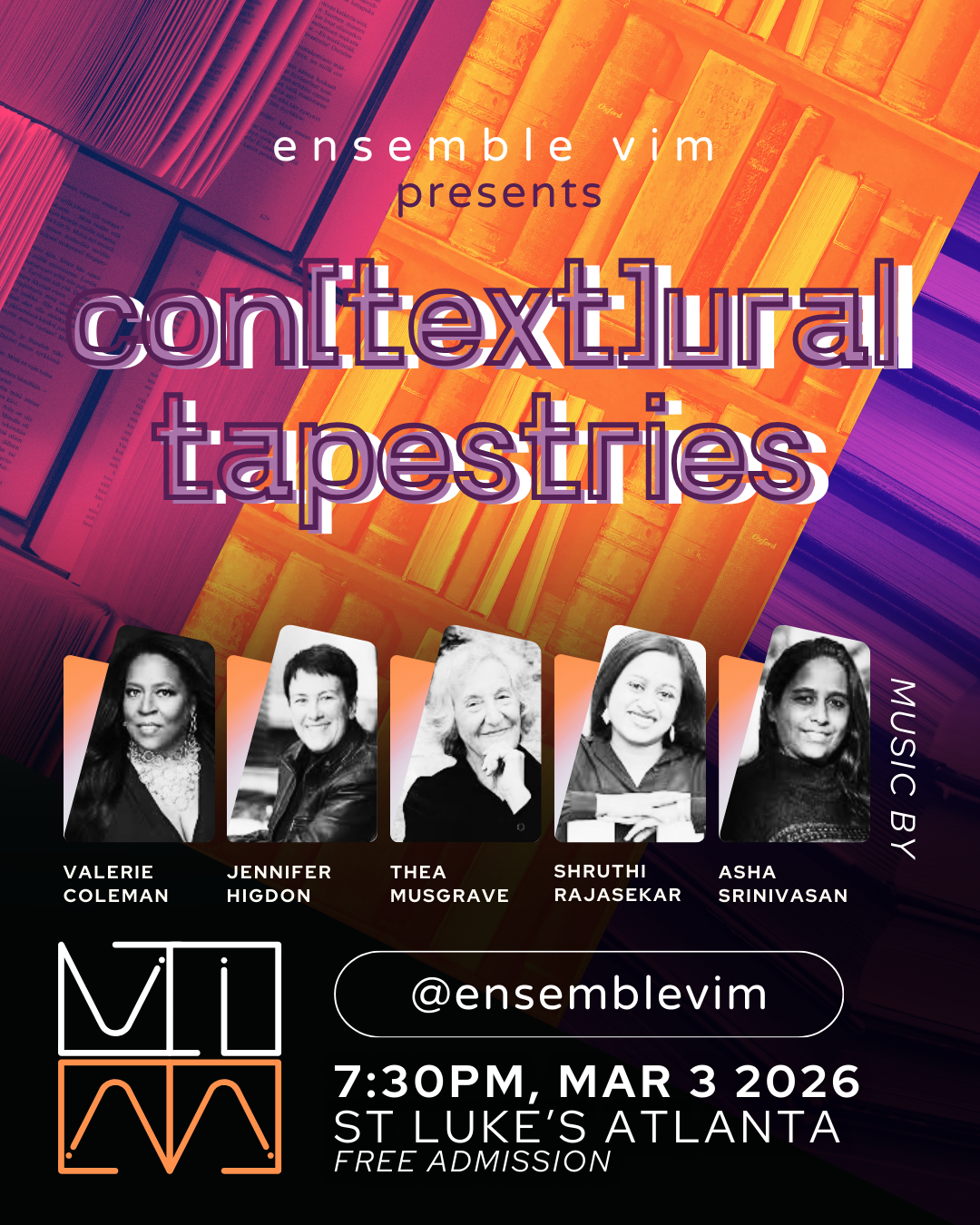
ensemble vim presents
Contextural Tapestries:
A Women’s History Month Celebration
March 3 2026 | 7:30pm | St Luke’s Atlanta
We encourage you to take photos (no flash please!) and videos of tonight’s performance
and tag us on social media @ensemblevim!
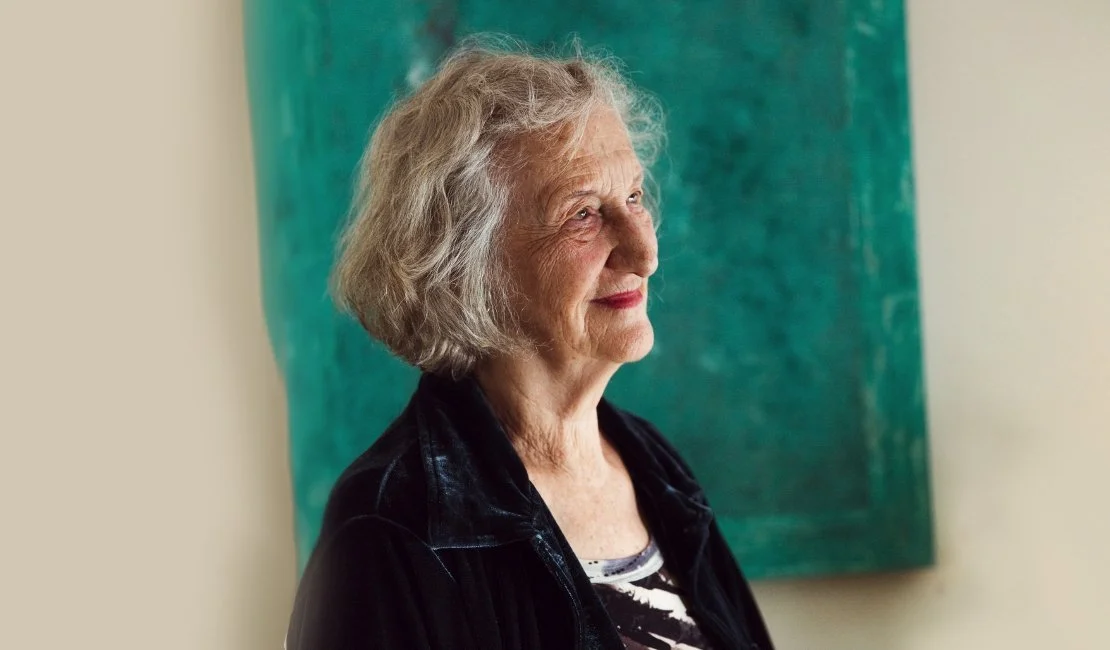
Thea Musgrave, composer
Canta Canta (1997)
by Thea Musgrave
Christina Smith, flute
Laura Usiskin, cello
Choo Choo Hu, piano
-
This short song—Canta Canta—is taken from A Cantata for a Summer’s Day written in 1954 while the composer was a student in Paris. The poems of the Cantata describe a summer’s day in all its moods, from pleasant sunshine to the memory of winter in the cool evening mist. The Cantata had its first performance at the Edinburgh International Festival of 1955.
The original song of this work is a setting of a poem by Maurice Lindsay. It describes the orange tiger lily burning bright in the hot summer sun.
-
Rich and powerful musical language and a strong sense of drama have made Scottish-American composer Thea Musgrave (b. 1928) one of the most respected and exciting contemporary composers in the Western world. Her works are performed in major concert halls, festivals, and radio stations on both sides of the Atlantic.
Known for the clarity of her invention, the skill of her orchestrations, and the power of her musical communication, Musgrave has consistently explored new means of projecting essentially dramatic situations in her music, frequently altering and extending the conventional boundaries of instrumental performance by physicalizing their musical and dramatic impact: both without programmatic content (such as the Clarinet Concerto, the Horn Concerto, the Viola Concerto, and Space Play), and others with specific programmatic ideas (such as the paintings in The Seasons and Turbulent Landscapes, the poems in Ring Out Wild Bells, Journey through a Japanese Landscape, and Autumn Sonata, and the famous Greek legends in Orfeo, Narcissus, Helios, and Voices from the Ancient World); -- all extensions of concerto principles. In some of these, to enhance the dramatic effect, the sonic possibilities of spatial acoustics have been incorporated: in the Clarinet Concerto the soloist moves around the different sections of the orchestra, and in the Horn Concerto the orchestral horns are stationed around the concert hall. Thus the players are not only the conversants in an abstract musical dialogue, but also very much the living (and frequently peripatetic) embodiment of its dramatis personae.
Her ten large-scale and several chamber operas of the past 40 years beginning with The Voice of Ariadne (1972) and followed by Mary, Queen of Scots (1977), A Christmas Carol (1979), Harriet, The Woman Called Moses (1984), Simón Bolívar (1992), Pontalba (2003) are in every sense the true successors to these instrumental concertos.
Two major retrospectives in recent years have shown the immense diversity of her music: the BBC’s Total Immersion weekend in 2014 and the Stockholm International Composer Festival 2018, in which fifteen of her orchestral and chamber works in four concerts — the largest profile of her music to date. Musgrave has been featured at many other major festivals including as Edinburgh, Warsaw Autumn, Florence Maggio Musicale, Venice Biennale, Aldeburgh, Cheltenham and Zagreb.Musgrave has been the recipient of many notable awards including two Guggenheim Fellowships, the Ivors Classical Music Award 2018, and The Queen's Medal for Music. She was awarded a CBE on the Queen's New Year's Honour List in 2002.
I saw You and I danced (2020)
by Shruthi Rajasekar
Laura Usiskin, cello
Choo Choo Hu, piano
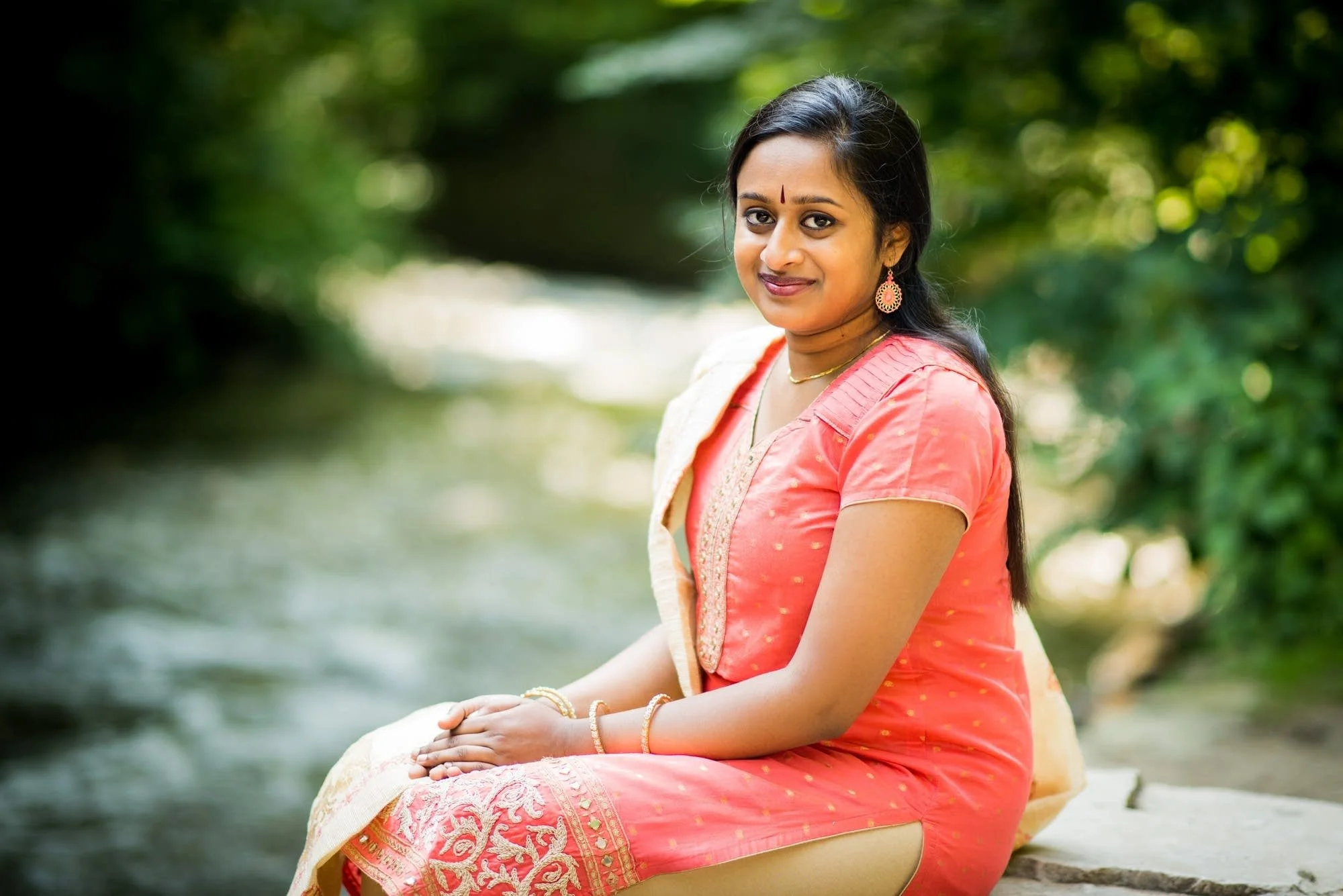
Shruthi Rajasekar, composer
-
I became curious about dance and devotion because of Errollyn Wallen’s Dervish. One particular text that I came across stayed with me— a passage from the second Book of Samuel in which David danced for the Lord with might and joy. This abandon, this exuberant movement made me consider how we can truly express ourselves to the ones we love. Not, “I saw you and I dithered,” or, “I saw you and I loved you but I was too urbane to say anything,” but, instead, living our lives with honesty, with integrity, with pure might and joy: “I saw You and I danced.” - Shruthi Rajasekar
-
Shruthi Rajasekar (b. 1996) is a 2025 ACF McKnight Composer Fellow with the American Composers Forum, a fellowship given to "outstanding mid-career artists." She was made an Associate of the Royal Northern College of Music (ARNCM) "in recognition of exceptional contributions made to the music profession" and was awarded a 2023-2025 Jerome Hill Artist Fellowship for "taking creative risks." Shruthi's compositions have won numerous honors, including the KHORIKOS ORTUS International Award, the Composers Guild of New Jersey Award, and the Global Women in Music Award from the Office of the United Nations High Commissioner for Human Rights & Donne in Musica Adkins Chiti Foundation. BBC Music Magazine named Shruthi a 2020 Rising Star. Performed in North America, Europe, and Asia in venues such as the Royal Albert Hall (London, UK), the Cannes Film Festival (France), the National Centre for Performing Arts (Mumbai, India), and Victoria Hall (Singapore), Shruthi's music has additionally reached thousands of listeners across the world on BBC Radio 3 & 4, Spotify's Official Classical Releases, Minnesota Public Radio, and more.
Shruthi's diverse output reflects her diasporic South Asian identity, her dual performance background in Carnatic (South Indian classical) and Western classical musics, and her belief in the importance of communal gathering and civic engagement. Recent projects include Sarojini (a large choral-orchestral and Indian ensemble composition about the Indian Independence Movement) and Whose Names Are Unknown (a choral-instrumental climate action and workers' rights piece), the multimedia work Parivaar commissioned by the Schubert Club, new vocal pieces for VOCES8, The Gesualdo Six, ORA Singers, Seattle Pro Musica, and Yale University's Institute of Sacred Music, and large ensemble, chamber, and solo instrumental works such as To ask is to listen, a new cross-genre composition commissioned by Wigmore Hall for Abel Selaocoe & the Hermes Experiment. In addition to working with today's leading musicians, Shruthi is passionate about composing for early performers and has created multiple educational pieces for ABRSM. Shruthi's work has been recorded by the BBC Singers, the National Youth Choirs of Great Britain, Maithree, Corvus Consort, Somerville College (University of Oxford), and Queens College (University of Cambridge), among others. In November 2021, her music was performed at the United Nations COP26. Shruthi has been an artist-in-residence at Britten Pears Arts (Snape, UK), Tusen Takk Foundation (Michigan, USA), and the Anderson Center (Minnesota, USA).
An award-winning Carnatic and Western classical vocalist, Shruthi is equally adept in traditional and experimental settings. She has performed at Kampenjazz (Oslo, Norway), Snape Maltings (Aldeburgh, UK), Kommune (Sheffield, UK), Source Song Festival (Minneapolis, USA), and Margazhi Ethnic New Year (Chennai, India), among other venues around the world. Her performance gurus and teachers have been her mother, the internationally renowned musician Vid. Nirmala Rajasekar, and Dr. Rochelle Ellis (Westminster Choir College), Jerry Elsbernd, and Patricia Rozario, OBE (Royal College of Music, UK). She received additional guidance in Carnatic music and musicology from the late vocal exponent Shri B. Seetarama Sarma and veteran scholar Dr. B.M. Sundaram. Honors during her studies include “Best On-Stage Presentation” at the national Carnatic Music Idol USA: Season 3 and first place at the Minnesota-NATS Competition.
Shruthi has been a guest presenter and/or composer-in-residence at the University of South Carolina, Reed College, Ahmedabad University, Westminster Choir College, University of Western Ontario, St. Olaf College, University of Minnesota, and more. Shruthi is an Honorary Music Patron of Hertfordshire Chorus and serves on the board of directors for the international artist center Anderson Center and for new music chamber ensemble Zeitgeist. She completed her Marshall Scholarship in the United Kingdom at SOAS, University of London (M.Mus. Ethnomusicology, Supervisors: Richard Widdess and Richard Williams) and the Royal Northern College of Music (M.Mus. Composition, Teachers: Adam Gorb and Laura Bowler). Shruthi graduated with the Edward T. Cone Prize from Princeton University, where she received composition instruction from Donnacha Dennehy, Barbara White, Andrew Lovett, Dan Trueman, and Juri Seo.
Dviraag (2009)
by asha srinivasan
Christina Smith, flute
Laura Usiskin, cello
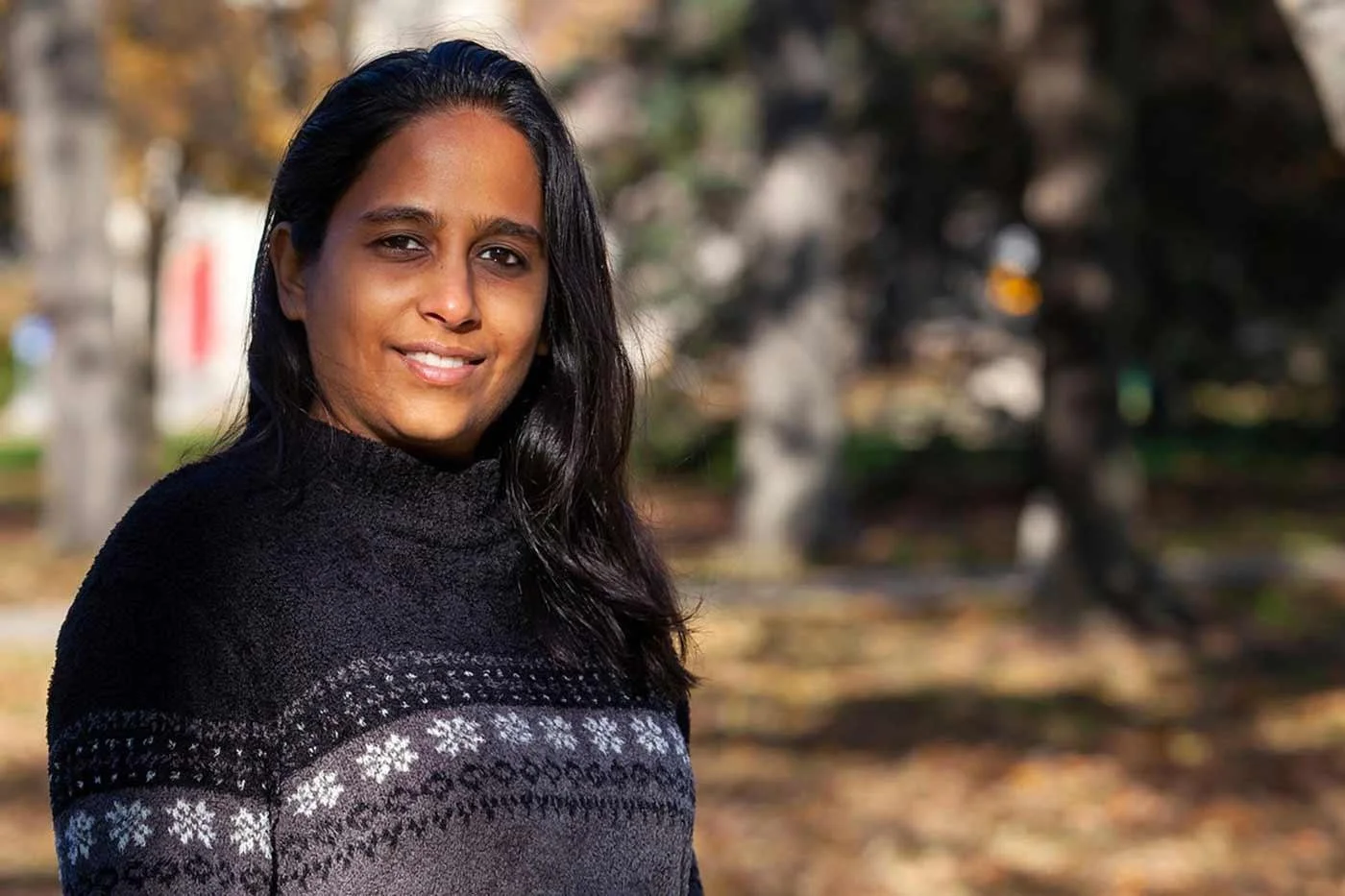
Asha Srinivasan, composer
-
Indian-American composer Asha Srinivasan draws from her Western musical training and her Indian heritage to create her compositional language. Crafted for concert and contest settings, this piece seamlessly blends traditional influences with contemporary flair, creating an engaging soundscape. “Dviraag” was a winner of the Flute New Music Consortium competition in 2015 and the Ruam Samai award at the Thailand International Composition Festival in 2011.
-
Indian-American composer Asha Srinivasan draws from her Western musical training and her Indian heritage to create her compositional language. Her music has been presented at various venues and has been discussed in dissertations and scholarly work. In 2019, she was commissioned by the East Carolina University NewMusic Initiative Commissioning Program. Her composition Dviraag was awarded at the 2011 Thailand International Composition Festival and won the 2015 Flute New Music Consortium competition. In 2012, Alarm Will Sound premiered Svara-lila at the Mizzou International Composers Festival. She has also won national commissioning competitions, including the BMI Foundation's Women's Music Commission and the Flute/Cello Commissioning Circle. Her works have been released on CD by MSR Classics, Ablaze Records, Mark Records, Beauport Classical, and SEAMUS CD Series (vol. 22). From 2016-18, she served on the board of the American Composers Forum and served as panel judge in 2017 and 2018 for the National Endowment for the Arts. In 2012, she co-hosted the SEAMUS national conference at Lawrence University. Her studies include: D.M.A. Composition at University of Maryland, College Park; M.Mus. Computer Music Composition and Music Theory Pedagogy at the Peabody Conservatory, and B.A. at Goucher College. Ms. Srinivasan is currently an Associate Professor of Music at Lawrence University. For further details about her other works, please visit twocomposers.org.
Amazonia (2022)
by Valerie Coleman
Christina Smith, flute
Choo Choo Hu, piano
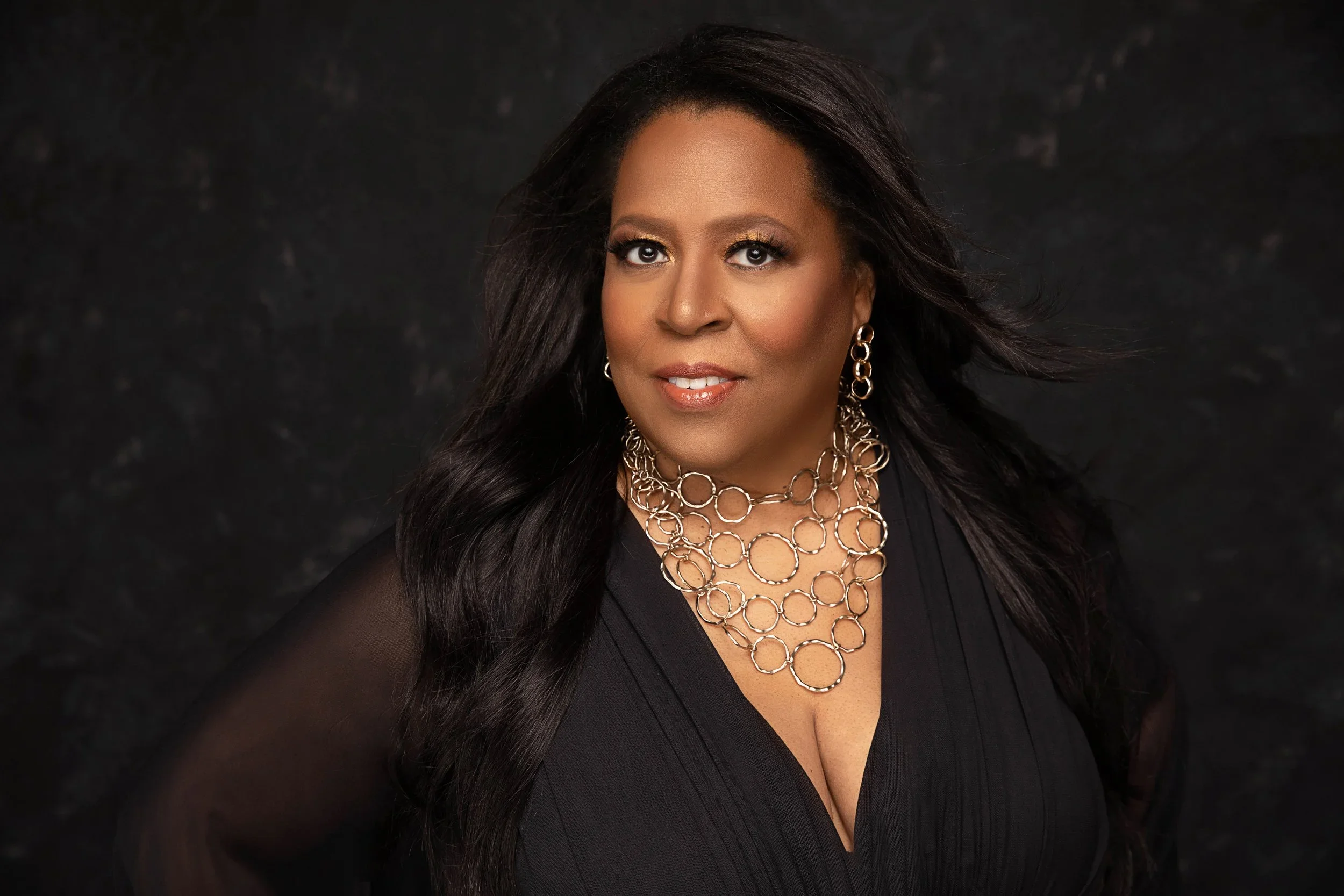
Valerie Coleman, composer
-
Amazonia is a commemoration poem of what is considered to be the “lungs of the earth”. The poem describes its natural beauty that progressively becomes destroyed, as the dark aspects of human nature intrude upon vitality. The work begins at Sunrise with the sounds of nocturnal animals like frogs and insects enjoying the last parts of the night, with the sounds of croaking and leaves moving erratically throughout the foliage. Tree frogs, Tamarin monkeys, and macaws sing their sounds, while drips of dew fall from the leaves, and provides a raindrop-esque motif throughout the first part of the work. The opening motif in the flute gives a fragmented taste of the grooves and rhythms found in Brazilian music.
As the Amazonia scene is set, a simple melody emerges representing the carefree children of the Amazon, who innocently play throughout the jungle and river, immune to the dangers that lurk around them. The melody itself is a sweet dance that turns to a more mature stance that describes the peaceful pride of the tribal adults. Theirs is an intentional way of life that is unimpeded by technology and urban landscape, greed and crime. Following a brief flute cadenza, the section ends with a still life Sunset of reds, oranges and yellows.
As the work unfolds, darker elements soon cloud the landscape, in a section called “Menacing”. The piano ominously marks the entrance of poachers and mercenaries into the rainforest, with an aggressive yet stealthy march. Their job is to drive out the tribes from the forest through intimidation and assault. Here the flute becomes the aggressor as its lower register articulates the word, fire in Morse code, as an impending signal to the burnings that will soon occur. Elements of Samba emerge within the following più mosso section, with the piano part dancing a macabre dance that symbolizes greed, as corporate interests circle the forest like vultures about to feast on the defenseless. Shouts, run, and anger precede the start of fire trickling through the rainforest, signified by a single note shared between the flute and piano that chromatically undulates and becomes more intense as the fires build and consume. Amazonia ends in an intense panic of shrieks and screams.
As the fires in the Amazon rainforest have decimated thousands of acres, we must remember the beauty of what once was. - Valerie Coleman
-
Valerie Coleman is regarded by many as an iconic artist who continues to pave her own unique path as a composer, GRAMMY®-nominated flutist, and entrepreneur. Highlighted as one of the “Top 35 Women Composers” by The Washington Post, she was named Performance Today’s 2020 Classical Woman of the Year, an honor bestowed to an individual who has made a significant contribution to classical music as a performer, composer or educator. Her works have garnered awards such as the MAPFund, ASCAP Honors Award, Chamber Music America’s Classical Commissioning Program, Herb Alpert Ragdale Residency Award, and nominations from The American Academy of Arts and Letters and United States Artists. Umoja, Anthem for Unity was chosen by Chamber Music America as one of the “Top 101 Great American Ensemble Works” and is now a staple of woodwind literature.
Coleman commenced her 2021/22 season with the world premiere of her latest work, Fanfare for Uncommon Times, at the Caramoor Festival with the Orchestra of St. Luke’s. In October 2021, Carnegie Hall presents her work Seven O'Clock Shout, commissioned by The Philadelphia Orchestra, in their Opening Night Gala concert featuring The Philadelphia Orchestra and Yannick Nézet-Séguin. This follows on the success of the world premiere of Coleman’s orchestral arrangement of her work Umoja, commissioned by The Philadelphia Orchestra and performed in Philadelphia and at Carnegie Hall in 2019, marking the first time the orchestra performed a classical work by a living female African-American composer. In February 2022, The Philadelphia Orchestra and soprano Angel Blue, led by Nézet-Séguin, will give the world premiere of a new song cycle written by Coleman, commissioned by the orchestra for performances in Philadelphia and at Carnegie Hall.
Coleman has been named to the Metropolitan Opera/Lincoln Center Theater New Works dual commissioning program in 2021/22. This season sees performances of her works by orchestras around the United States including the Minnesota Orchestra, Baltimore Symphony Orchestra, Sarasota Orchestra, New Haven Symphony Orchestra, Yale Symphony Orchestra, Vermont Symphony and The Louisville Orchestra. Recent commissions include works for the Orpheus Chamber Orchestra, The Library of Congress, Orchestra of St. Luke’s, American Composers Orchestra, The National Flute Association, University of Chicago and University of Michigan. Previous performances of her works have been with the New York Philharmonic, Boston Symphony Orchestra, Pittsburgh Symphony, St. Louis Symphony, Atlanta Symphony Orchestra, Toronto Symphony and significant chamber ensembles and collegiate bands across the country.
Former flutist of the Imani Winds, Coleman is the creator and founder of this acclaimed ensemble whose 24-year legacy is documented and featured in a dedicated exhibit at the Smithsonian National Museum of African American History and Culture in Washington, D.C. Along with composer-harpist Hannah Lash, and composer-violist Nokuthula Ngwenyama, she co-founded and currently performs as flutist of the performer-composer trio Umama Womama.
As a performer, Coleman has appeared at Carnegie Hall and The Kennedy Center and with The Philadelphia Orchestra, Hartford Symphony, New Haven Symphony, Boston University Tanglewood Institute, Orpheus Chamber Orchestra, Banff, Spoleto USA and Bravo! Vail. As a guest flutist, she has participated in the Mid-Atlantic Flute Fair, New Jersey Flute Fair, South Carolina Flute Society Festival, Colorado Flute Fair, Mid-South Flute Fair and the National Women’s Music Festival. In 2021/22, Valerie will appear at a host of festival and collegiate multi-disciplinary residencies, including Orchestra of St. Luke’s, Chamber Music Northwest, Phoenix Chamber Music Society, University of Michigan and Coastal Carolina University. Coleman will be the featured guest artist at the Long Island Flute Club, Raleigh Area Flute Association, Greater Portland Flute Society, Seattle Flute Society, University of Wisconsin-Madison Flute Day, Bethune-Cookman University Flute Day and the Florida Flute Society Festival.
As a chamber musician, Coleman has performed throughout North America and Europe alongside Dover Quartet, Orion String Quartet, Miami String Quartet, Harlem String Quartet, Quarteto Latinoamericano, Yo-Yo Ma, Ani and Ida Kavafian, Anne-Marie McDermott, Wu Han, David Shifrin, Gil Kalish, members of the Los Angeles Chamber Orchestra, and jazz legends Paquito D’Rivera, Stefon Harris, Jason Moran and René Marie. A laureate of Concert Artists Guild, she is a former member of Chamber Music Society of Lincoln Center CMS Two.
Coleman’s work as a recording artist includes an extensive discography. With Imani Winds, she has appeared on Sony Classical, Deutsche Grammophon, Sony Classical, Naxos, Cedille Records and eOne, and as a guest flutist on albums with Wayne Shorter Quartet, Steve Coleman and the Council of Balance, Chick Corea, Brubeck Brothers, Edward Simon, Bruce Adolphe, and Mohammed Fairouz. Her compositions and performances are regularly broadcast on NPR, WNYC, WQXR, Minnesota Public Radio, Sirius XM, Radio France, Australian Broadcast Company and Radio New Zealand.
Committed to arts education, entrepreneurship and chamber music advocacy, Coleman created the Imani Winds Chamber Music Festival in 2011, a summer mentorship program in New York City welcoming young leaders from over 100 international institutions. She has held flute and chamber music masterclasses at institutions in 49 states and over five continents, including The Juilliard School, Curtis Institute, Manhattan School of Music, Mannes College of Music, New England Conservatory, Oberlin College, Eastman School of Music, Yale University, Carnegie Mellon, Interlochen Arts Academy, Beijing Conservatory, Brazil’s Campo do Jordão Festival and Australia’s Musica Viva. As a part of Imani Winds, she has been artist-in-residence at Mannes College of Music, Banff Chamber Music Intensive and Visiting Faculty at the University of Chicago.
In February 2024, Coleman was appointed to the Composition Department faculty at The Juilliard School. She is the Director of the Woodwind Quintet Workshop at Boston University Tanglewood Institute and holds faculty positions with the Manhattan School of Music, Mannes School of Music Flute and Composition Department and Norfolk Chamber Music Festival. Coleman previously served on the faculty at The Frost School of Music at the University of Miami as Assistant Professor of Performance, Chamber Music and Entrepreneurship.
She adjudicates for the National Flute Association’s High School Artist Competition, Concert Artist Guild, APAP’s Young Performing Concert Artists Program, ASCAP’s Morton Gould Award, MapFund Award and the Fischoff National Chamber Music Competition and has served on the Board of Advisors for Composers Now, Sphinx LEAD, APAP’s Classical Connections Committee and the National Flute Association’s New Music Advisory Committee and Board Nomination Committee.
Coleman’s compositions are published by Theodore Presser and her own company, Coleman Page Publishing. She studied composition with Martin Amlin and Randy Wolfe and flute with Julius Baker, Judith Mendenhall, Doriot Dwyer, Leone Buyse and Alan Weiss. She and her family are based in New York City.
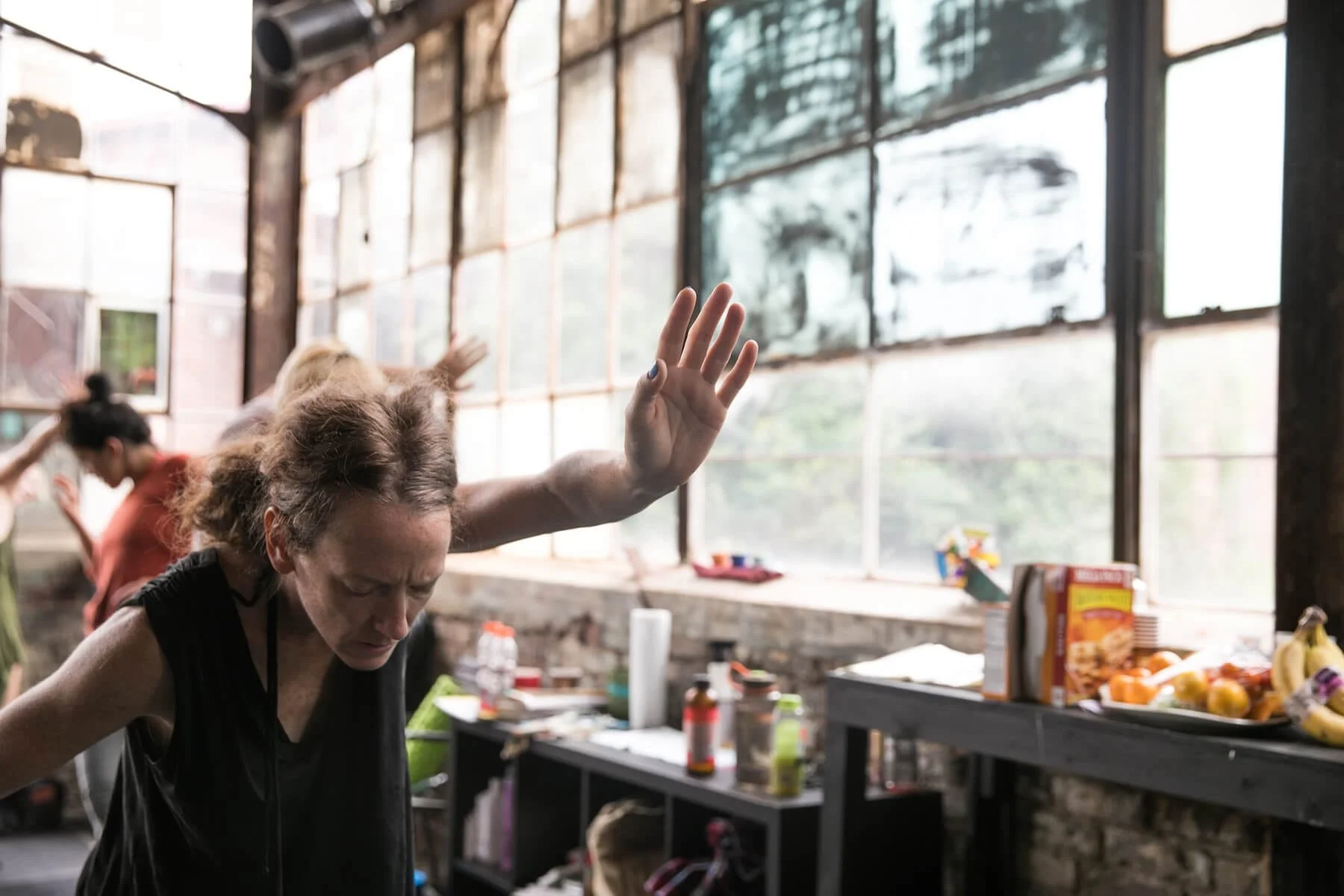
lauri stallings, choreographer
Vignette (2026)
choreography by lauri stallings
Zandia Covington, glo moving artist
Ashley Ianna Daye, glo moving artist
Mary Jane Pennington, glo moving artist
Christina Smith, flute
Laura Usiskin, cello
Choo Choo Hu, piano
-
In Vignette, moving artists and musicians are seamlessly integrated, hardly without separation between their roles, sharing the space directly. Placing this unique piece in between Valerie Coleman’s Amazonia and Jennifer Higdon’s American Canvas, choreographer lauri stallings treats the flute, cello, and bodies as raw, expressive instruments that bypass traditional forms. Vignette adds a moving dimension to the concert while illustrating the historical contexts of St. Luke’s, founded in 1864, as a beacon for community. Outreach and social justice organizations The Frazer Center, Crossroads Community Ministries, and Atlanta Community Food Bank, all began on the grounds of St. Lukes.
-
lauri stallings (choreographer) is a Georgia artist. Whether inhabiting a forest of 80 acres, or confined to the surface of a beam of light, the origin of stallings’ art extends outwards from the primary projections of the feet and hands. Her wide-ranging practice draws on civic engagement as much as formal movement to engage with notions of entanglement, as well as parameters of place and the ways in which people come together. stallings path as an artist began when her older brother Luke made it possible.
American Canvas (2018)
by Jennifer Higdon
Christina Smith, flute
Laura Usiskin, cello
Choo Choo Hu, piano
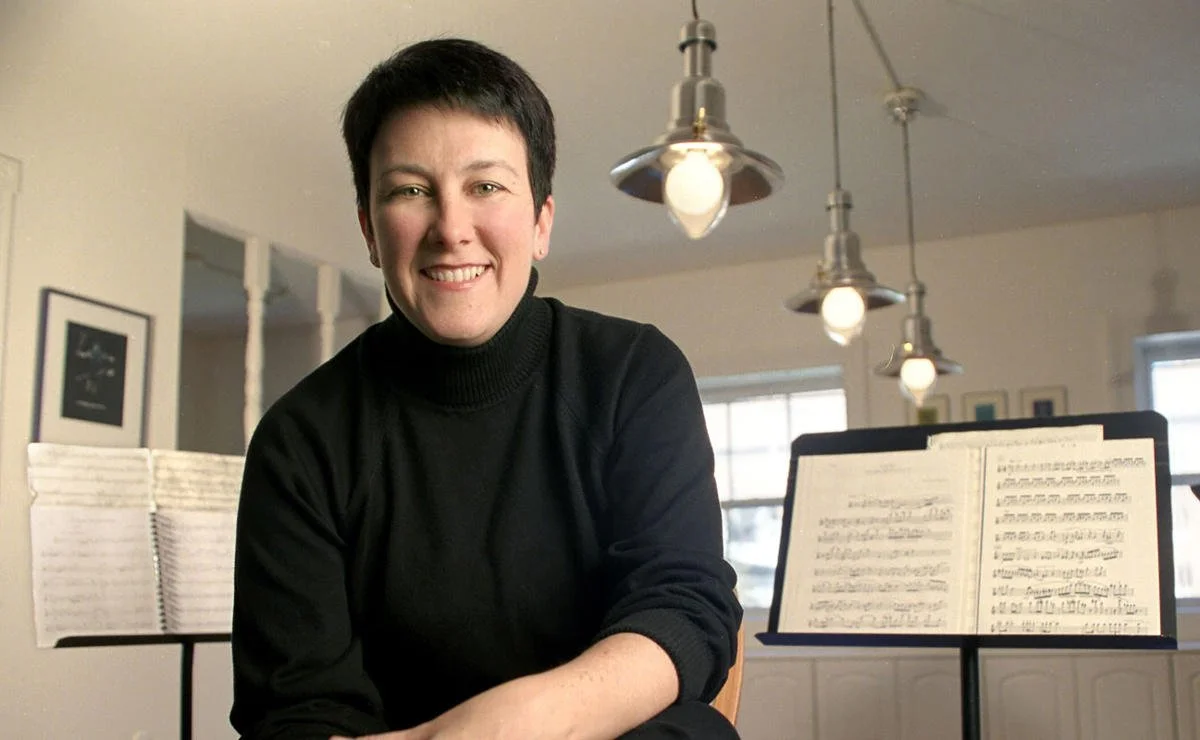
Jennifer Higdon, composer
-
Excerpt from an interview with Jennifer Higdon: “[This] summer I was out in Santa Fe, so I got a chance to really experience O’Keeffe, touring the O’Keeffe museum, also her house, one of her houses is in Abiquiu, where she worked. They still have the canvases there. They still have the studio she worked in. And being around the landscape where she painted so much out there, it made a real impression on me.
And I’ve read the biographies of all of these painters, so I feel fairly versed, and the way they thought about what they put on the canvas, and also the way they would sometimes come back to certain subjects.
Pollock is mostly known for those splatter paintings. And of the three artists, he had the fewest canvases, because he had the shortest life.
Andrew Wyeth is actually the person who lived the longest. And, I find everything he’s ever painted just incredible to look at. And they’ve recently opened his studio down at the Brandywine. So, probably about a year ago, I went down there and took a tour of it; just a regular tour, and I loved seeing where he worked. Looking at the floor, the boards, they have all of the paints around, you know, empty egg cartons. It’s just completely fascinating. You know, I think there was a movie - Ed Harris did it at some point - that was on his life, and I read the biography on him as well.
But because they were all different, and their canvases were all so striking and they made quite a mark on American visual artistry, I thought those three would be perfect together.” The piece is originally written in this order: O’Keeffe, Pollock, Wyeth, but the composer gave permission to have the movements performed in whatever order best suits the players.
-
Jennifer Higdon was born on New Year’s Eve, 1962 (Brooklyn, NY). She didn’t start playing an instrument until she taught herself to play the flute at the age of 15 and began formal studies at 18 when she entered college. Despite this late start, the Pulitzer Prize and three-time Grammy winner has become a major figure in Classical music and is one of the few individuals in the U.S. who makes her living from commissions. Higdon averages 300 performances a year of her works, in many genres within classical music: from opera to chamber, symphonic to band, solo works to concerti. She has even written works in forms not tackled before: a bluegrass/classical hybrid concerto, a concerto for the entire low brass section of an orchestra (at the request of Maestro Ricardo Muti), and one that features 6 soloists (for Eighth Blackbird).
After receiving the 2010 Pulitzer Prize for her Violin Concerto, Higdon also won a Grammy for her Percussion Concerto...a singular feat which no other classical composer has ever managed: two of the biggest major awards for two different pieces in one year. Additionally, she was awarded one of the largest and most prestigious composition prizes in the world, The Nemmers Prize in Music from Northwestern University. She has also received a Guggenheim Fellowship, two awards from the American Academy of Arts & Letters, the Koussevitzky Foundation Fellowship, the Pew Fellowship in the Arts, an Independence Foundation Grant, and funding from the NEA. A winner of the Van Cliburn Piano Competition’s American Composers Invitational, her Secret & Glass Gardens was performed by the semi-finalists in 2005. Her first opera, Cold Mountain, sold out its premiere run in Santa Fe, as well as in North Carolina, and Philadelphia (becoming the third highest selling opera in Opera Philadelphia’s history). Cold Mountain won the prestigious International Opera Award for Best World Premiere in 2016; the first American opera to do so in the award’s history.
Her music has been hailed by Fanfare Magazine as having “the distinction of being at once complex, sophisticated but readily accessible emotionally”, with the Times of London citing it as “…traditionally rooted, yet imbued with integrity and freshness.” The Chicago Sun Times recently cited her music as “both modern and timeless, complex and sophisticated, and immensely engaging in a way that both charms and galvanizes an audience craving something new and full of urgency, yet not distancing.” John von Rhein of the Chicago Tribune called her writing, “beautiful, accessible, inventive, and impeccably crafted.”
Higdon's list of commissioners is extensive and includes The Philadelphia Orchestra, The Chicago Symphony, The Cleveland Orchestra, The Atlanta Symphony, the Munich Philharmonic and the St. Paul Chamber Orchestra, as well such groups as the Tokyo String Quartet, the Lark Quartet, Eighth Blackbird, and the President’s Own United States Marine Band. She has also written works for such renowned artists as baritone Thomas Hampson and mezzo Sasha Cooke; pianists Yuja Wang and Gary Graffman; and violinists Joshua Bell, Nadja Salerno-Sonnenberg, Jennifer Koh, and Hilary Hahn.
Her orchestral work, blue cathedral, is one of the most performed contemporary works in the orchestral repertoire and is widely considered the first work in the 21st century to have become part of the standard repertoire. Since its premiere in 2000, it has received over 850 performances.
Higdon’s works have been recorded on more than 90 CDs. She has won Grammys for her Percussion Concerto, Viola Concerto and her Harp Concerto. Her work, All Things Majestic, written for the Grand Teton Music Festival, is part of that national park’s visitor center experience. The Library of Congress has added the recording of her Percussion Concerto to the National Recording Registry.
She was recently inducted into the American Academy of Arts and Letters and the American Philosophical Society (founded by Benjamin Franklin).
For up-to-date information: www.jenniferhigdon.com

Ensemble Vim
-
Christina Smith (flutist) has played Principal Flute in the ASO since 1991. Her career passions are playing in one of the most superlative American orchestras, performing chamber music with wonderful colleagues, and teaching the next generation of superstar musicians. She lives in Atlanta with her husband and two college age daughters, and her favorite place to be is the west coast of the US.
-
Laura Usiskin (she/her) is dedicated to enriching the world through music performance, education, and innovation. With a specialization in chamber music, Usiskin believes that the world is a more beautiful place when there is collaboration and communication through the arts. She lives in a round house in Atlanta, where she teaches, rehearses, and attempts to cook for her family.
-
Choo Choo Hu (pianist) has been playing the piano since the age of five. Her music has brought her to the far corners of this weird, wonderful world, and she loves nothing more than to use music to create spaces of shared community and gathering. Other loves include cooking, travel, yoga, her dog Oscar, and her husband Mike, in no particular order of importance.

-
Zandia Covington (moving artist) engages in work defined by an innate connection in presence, unwavering embrace of raw emotion, and co-exploring the vulnerable tapestry of lived experiences. Transcending formal training in upbringing, Zee has carved a distinct path through ritual, accompaniment of ancestors, deep listening to the body, and curiosity.
-
Ashley Daye (moving artist) is a multidisciplinary artist, designer, and somatic practitioner whose work centers embodied research, community exchange, and relational performance practices. She’s been a moving artist with glo since 2013, contributing to numerous projects including The Traveling Show, a long-term rural engagement initiative cultivating connection through gestures and cultural reciprocity across the U.S. South.
-
Mary Jane Pennington (moving artist) is a seventh generation Georgian, named for my aunts, raised by my parents alongside my older brother in Dalton's valley inside the Appalachian foothills. Listening for admixtures deep within and all around, I grew up dancing, playing in the woods, still today I’m dancing, playing in the woods.
-
lauri stallings (choreographer) is a Georgia artist. Whether inhabiting a forest of 80 acres, or confined to the surface of a beam of light, the origin of stallings’ art extends outwards from the primary projections of the feet and hands. Her wide-ranging practice draws on civic engagement as much as formal movement to engage with notions of entanglement, as well as parameters of place and the ways in which people come together. stallings path as an artist began when her older brother Luke made it possible.
Next Up with ensemble vim:
May 3 2026, 2pm @ Kopleff Recital Hall / Georgia State University - Steve Reich’s Music for 18, in collaboration with Bent Frequency, atlcmc, Chamber Cartel and smol ensemble.
May 4 2026, 7:30pm @ Goat Farm ATL - spark2 launch concert, featuring works by Leah Asher, Lera Auerbach, Emily Koh, Lauren McCall, and Alfred Schnittke
Like what you experienced tonight?
You can make a difference.
As of 2021, ensemble vim is officially a 501(c)(3) non-profit organization, so your contributions are tax-deductible to the fullest extent of the law. We rely solely on donations and sponsors to continue what we do the best: reaching out to underserved groups, nurturing emerging artists, and providing performances with the highest artistic standards.
(Apple Pay is only available on the Safari browser)
Interested in becoming a board member?
ensemble vim is currently growing our board! Contact us to learn more.
Special Thanks!
St Luke’s Atlanta
Matthew Brown
Jason Rogers